Articles
AI Is Saving Time. Why Does Work Still Feel Demanding?
AI can improve output while changing the human work around it. Explore the evidence on monitoring, checking and the capacity AI actually releases.
Published
I keep hearing a strange version of the same story from colleagues using AI agents at work. AI is saving them time, yet they feel as though they are managing more things than ever.
The draft arrives faster. The analysis runs in the background. Another task moves forward while they concentrate elsewhere. Those are real gains. But someone still has to check the result, spot what is missing and decide whether it is good enough to use.
Increasingly, people are doing their own work while managing a parallel artificial workforce.
That raises a question for anyone assessing AI productivity: how much human work has disappeared, and how much has moved into supervision?
When performance and workload tell different stories
A recent peer-reviewed study offers a provocative starting point. In standardised office tasks involving 30 older workers, AI assistance improved task performance. During complex AI-assisted tasks, perceived workload was descriptively lower, while heart-rate variability and EEG measures indicated increased physiological and attentional demand. The authors describe a performance–workload paradox, linking the pattern to monitoring and verifying AI suggestions. Their interpretation is that AI may redistribute workload rather than eliminate it. [1]
This is a small laboratory study involving a specific age group and particular tasks. The accessible abstract cannot establish the detailed mechanism or tell us what happens across a working month. It does, however, challenge an easy assumption: better performance and an easier-feeling task do not necessarily mean every aspect of human demand has fallen.
The work that continues after delegation
Another study examined 642 hybrid employees across two survey waves seven weeks apart. It introduced “AI process vigilance”: continuing to monitor progress, anticipate errors, worry about output quality and retain responsibility for delegated work. Greater dependence on AI delegation was associated with greater vigilance. Vigilance was associated with work-related rumination, which was associated with poorer psychological detachment and recovery. [2]
These are observational associations, not proof that delegation causes poorer recovery. AI process vigilance is also a new research construct rather than an established universal measure. Still, it gives a name to a recognisable experience: a task can leave your hands without leaving your attention.
Consider an agent preparing a client analysis while you write a proposal. You may have delegated the analysis, but you remain alert to its progress. You check whether its sources are sound. You correct an assumption. You decide when to intervene.
Execution has changed. Responsibility remains with you.
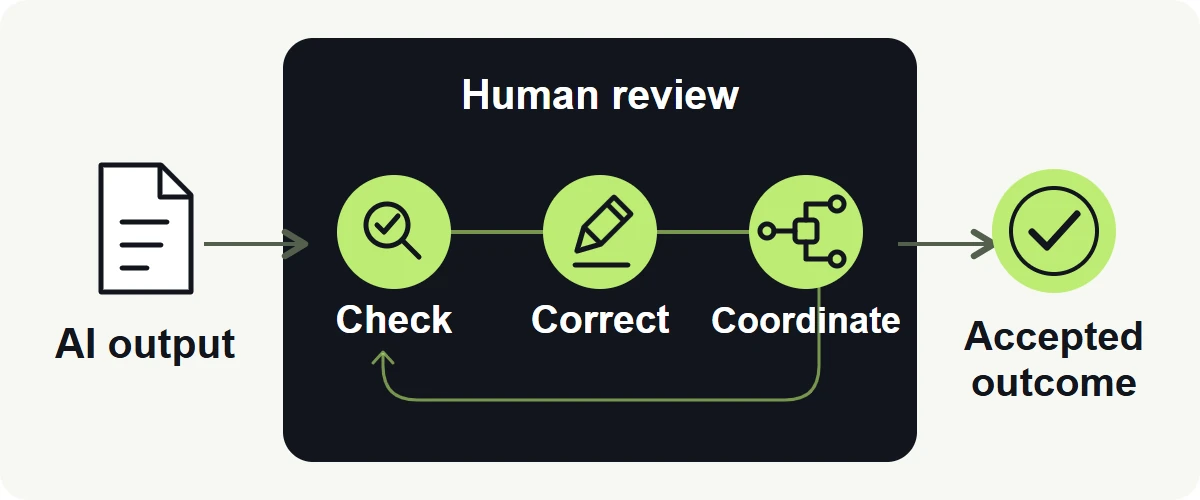 The human work between AI output and an accepted outcome.
Output can conceal the effort behind it
There is a useful historical parallel in Gloria Mark and colleagues’ interruption research. In a laboratory experiment involving 48 participants, mostly students, interrupted participants completed the primary task in less active task time, excluding interruption time. The researchers found no significant differences in the measured quality variables, but participants reported greater workload, stress, frustration, time pressure and effort. [3]
This was an interruption study, not evidence about AI. The analogy is narrower: people can maintain measured output while absorbing costs that the output measure misses.
An organisation might celebrate faster drafts or more completed tasks without seeing the checking, context switching and correction that made those results usable. That is a measurement gap, not evidence that the gains are imaginary.
The organisational question is similar. An August 2026 working paper by Chen and Stratton examines roughly 300 million work events across 718 software firms. It finds that coding productivity gains did not fully translate into final software output, with code review emerging as a bottleneck for agent adoption. [4]
The paper is not peer-reviewed evidence of cognitive workload. It illustrates a different issue: accelerating one stage does not guarantee equivalent gains across the whole work system. Producing code and getting useful software through review are different outcomes.
Three reasons humans supervise AI
For managers, the useful question is what people must do around AI output to make it trustworthy. Counting generated material answers only part of that question.
FlowQuota is exploring Supervision Burden as a way to investigate this surrounding work. Three proposed categories help make the discussion concrete:
Governance Supervision is oversight that legitimately needs to happen: checking a consequential recommendation, confirming compliance or approving a customer-facing result.
Learning Supervision is human input intended to improve future AI work: clarifying instructions, documenting a recurring error or establishing a reusable check. Claiming a realised benefit requires evidence that comparable later work improves because the feedback or check was retained and applied.
Rescue Supervision is intervention because the work has failed, drifted or become unacceptable: repairing an analysis, recovering a workflow or rewriting an unusable answer.
These categories are neither mutually exclusive nor exhaustive. A correction can rescue today's task and potentially help tomorrow's. The purpose is to understand the work, not force every action into one box or count the same effort twice. Leave an action unclassified when the evidence cannot distinguish its purpose.
Human Cognitive Return is the related research question: after supervision, correction, recovery and coordination, how much human capacity did AI actually release?
These are concepts FlowQuota is exploring, not released measurement capabilities or validated scores.
Run a small experiment on the work
You do not need physiological monitoring to start asking better productivity questions.
Choose one repeatable workflow with a clear accepted outcome: a checked research brief, an approved report or a completed software change. Establish a credible baseline using comparable work, with similar complexity and quality requirements.
Then observe what changes with AI assistance. Record the human time spent executing, supervising, coordinating and reworking the task. Avoid counting an intervention in several categories. Include the work needed to reach acceptance, rather than stopping the clock when the first output appears.
Alongside those observations, invite voluntary reflection on what felt easier, what remained demanding and whether attention stayed attached to the task after delegation. Use this to improve the workflow, not diagnose health or monitor individual employees.
Compare accepted outcomes and the human effort required to achieve them. If drafting improves but checking expands, investigate the checking. If repeated corrections lead to better later results, verify that improvement before claiming a return.
AI can create substantial value. Understanding where human work moves is how we make those gains more useful, more sustainable and easier to trust.
Sources
Abd Rahman et al., WORK (online 10 October 2026). Abstract available at PubMed: https://pubmed.ncbi.nlm.nih.gov/42858031/ DOI: https://doi.org/10.1177/10519815261492326 ↩︎
Zhang, Li and Chen, Frontiers in Psychology (24 September 2026). https://www.frontiersin.org/journals/psychology/articles/10.3389/fpsyg.2026.1914119/full ↩︎
Gloria Mark, Daniela Gudith and Ulrich Klocke, The Cost of Interrupted Work: More Speed and Stress (CHI 2008). https://www.ics.uci.edu/~gmark/chi08-mark.pdf ↩︎
Chen and Stratton, Artificial Intelligence in the Firm: Bottlenecks in Software Production (working paper, 4 August 2026). https://fion.ac/jellyfish.pdf ↩︎