See what is shaping your focused work.
A week can contain plenty of focused minutes and still feel fragmented. FlowQuota Focus Score turns the Focus evidence you choose to record into a current, explainable signal, so you can see what deserves attention and decide what to protect or change.
It reflects recorded focus behaviour, not the quality of your work or your ability.
How the score can move
Components can move independently, and a current score can rise, fall or remain broadly stable.
In this representative example, the Focus Score rises from 45 to 66 as all five component indicators move positively, and the band changes from Building consistency to Good focus base. Components can move independently, and a current score can rise, fall or remain broadly stable.
Minutes show volume. Focus Score reveals the pattern.
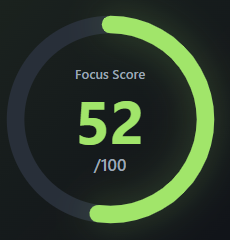
FlowQuota Focus Score is a 0–100 summary calculated from the Focus evidence recorded in your current rolling 14-day window. Focused minutes show volume. FlowQuota adds context to that time: the score summarises the current picture, the band helps you read it and the available trend shows whether that picture is shifting.
Together, they help you move from “How many minutes did I record?” to “What is shaping the way I focus?”
Score
A fast summary of the current recorded pattern.
Band
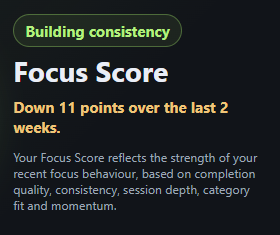
Plain-language context for reading the number without treating it as a grade.
Trend
A recent comparison when the preceding period contains enough evidence.
See what is shaping the score.
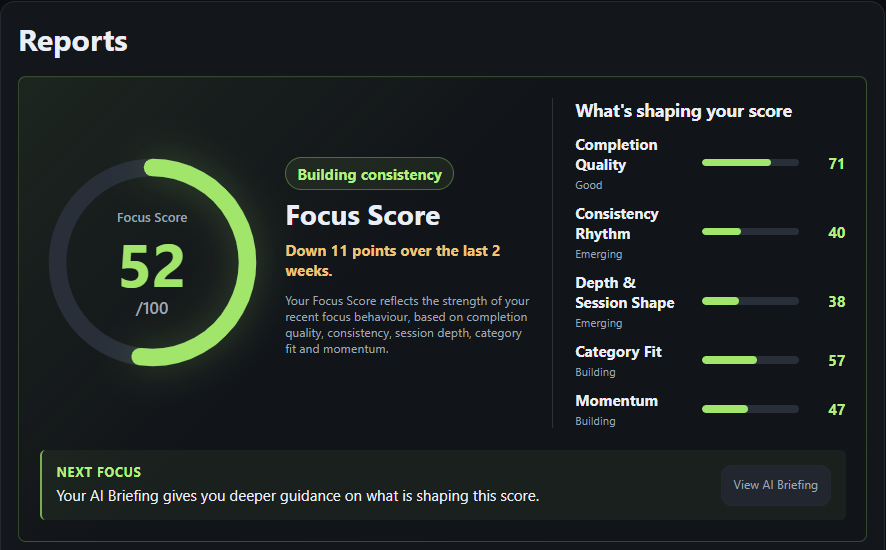
Five components help explain the current picture. They are prompts for investigation, not targets to maximise.
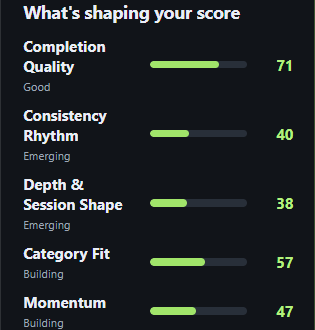
Completion Quality
Looks at how recorded Focus sessions resolve rather than treating raw duration as the whole story.
Consistency Rhythm
Looks for a sustainable spread of completed Focus sessions across recent days, rather than a single burst.
Depth & Session Shape
Considers whether completed sessions are substantial and bounded, including relevant session-extension evidence.
Category Fit
Looks for useful patterns across the work categories you define, without deciding which type of work matters most.
Momentum
Looks at how the current 14-day period compares with the preceding period when enough evidence exists.
Together, the components help you ask more useful questions. Is your focus spread across recent days or compressed into one burst? Are sessions reaching a clear outcome? Do different categories of work show different patterns?
Current evidence can change the picture.
Focus Score is recalculated from the evidence in your current rolling 14-day window. New records can enter the picture. Older records can leave it. Changes to recorded evidence can also affect what you see.
That means the score, band, components and available trend may change without every session producing an immediate gain. It is a current view, not a permanent grade.
Evidence enters
Recent recorded Focus behaviour becomes part of the current view.
Evidence leaves
Older records move beyond the rolling window.
The picture recalculates
FlowQuota calculates the current result from the evidence available when the view is requested.
FlowQuota waits before showing a score.
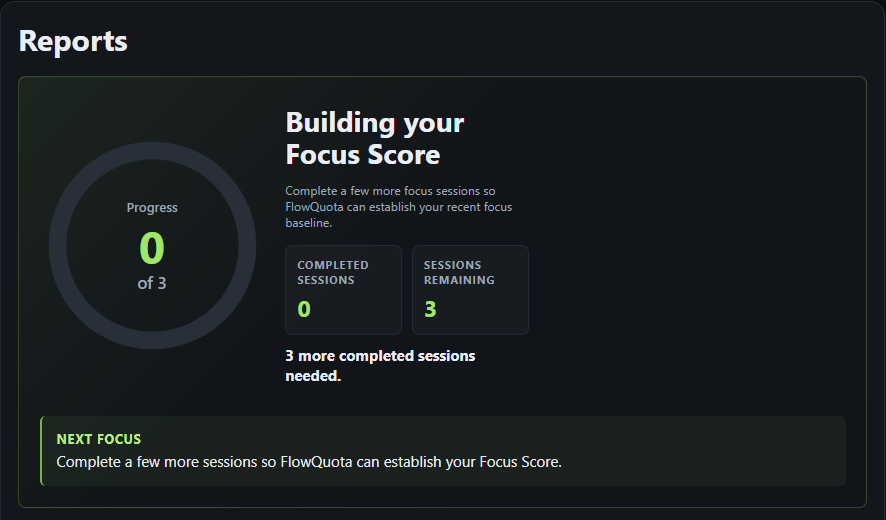
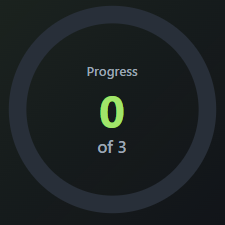
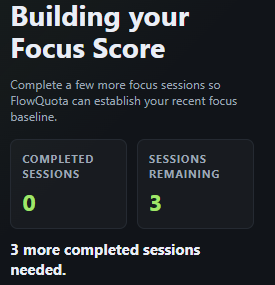
A numerical Focus Score appears after three completed Focus sessions exist in the current 14-day window. Before that, FlowQuota shows “Building your Focus Score” while the current evidence is still building.
Keep recording the Focus sessions that matter. The score will appear when the current window contains enough completed-session evidence.
Use the signal to decide where to look.
Use the score to find a useful question, then inspect the sessions, projects, times and categories behind it before deciding what the pattern means for your priorities.
Read the signal
Notice the score, band, component pattern and available trend.
Inspect the evidence
Use Reporting to examine the sessions, projects, times and categories behind your recent pattern.
Apply judgement
Decide what to protect, change or test next in the context of your own priorities.
The score is calculated before AI interprets it.
FlowQuota calculates Focus Score from defined product evidence. With FlowQuota AI, AI Briefings may help you interpret patterns and consider an adjustment.
AI does not calculate or change the score, and it cannot prove what caused a result.
Explore AI BriefingsStart with one Focus session.
Record the work that deserves your attention. As the evidence builds, FlowQuota gives you a clearer view of how your focused work is taking shape.