Turn focused work into evidence you can use.
FlowQuota is a focus-intelligence product for ambitious professionals. When reactive work fills the day, it can be hard to see whether important work received the attention it deserved.
Choose the work that matters, add its project and category, then start a focus session yourself. Each session creates a structured record of the focused work you chose to capture. As those records build, FlowQuota helps you see patterns and decide what to protect, change or test next. It does not passively monitor your day or measure the quality of your output.
- Choose
- Record
- Build evidence
- Review
- Decide
Repeat with the next piece of important work.
A practical loop from deliberate focus to useful evidence.
The timer is the sensor. It gives each session a deliberate start and turns that period of focused work into a structured record. The real value comes from what those records help you see over time.
Choose the work that deserves your attention.
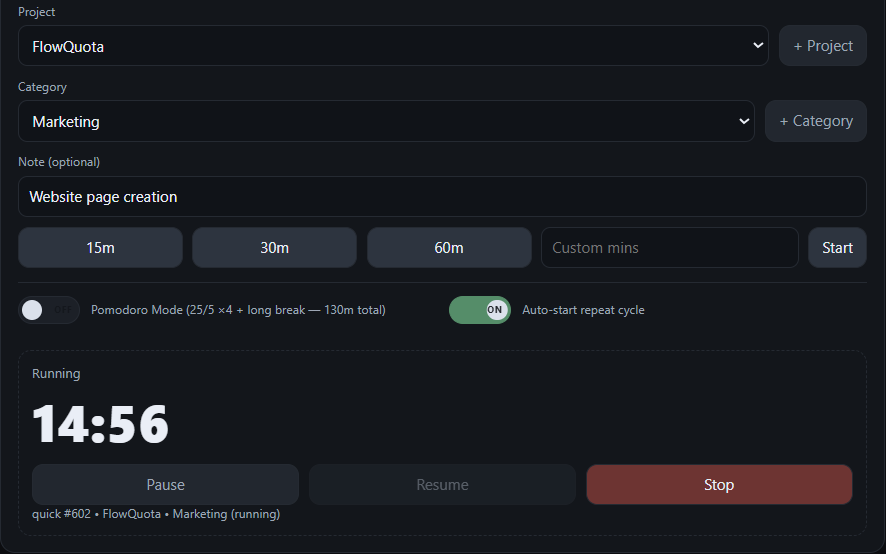
Select a project and category, choose a session length and add a note if it will help. Then start the session yourself.
While you work, you can pause or stop the session when you need to. FlowQuota records the focused work you deliberately choose to capture, rather than monitoring activity across your day.
Let the evidence build through use.
The first session you deliberately record creates one piece of evidence, not a verdict. As you record more of the focused work that matters, the evidence can become more representative of the work you choose to record, and therefore more useful.
No fixed number of sessions guarantees a pattern. The aim is a clearer view of the work you chose to focus on, not a complete account of everything you did.
Review where your focused time is going.
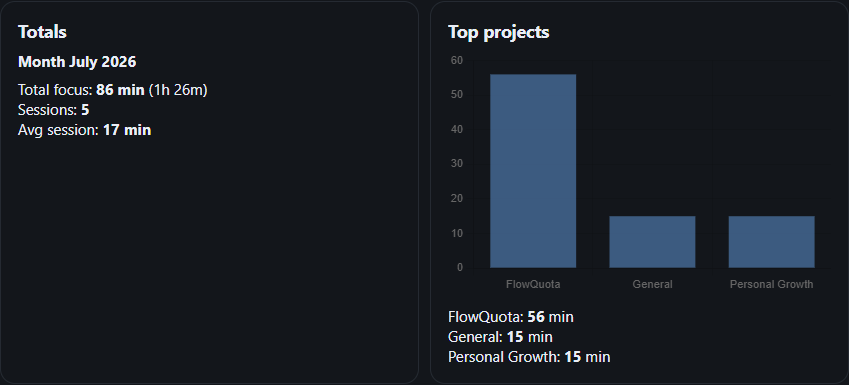
Reporting brings your recorded sessions together across a selected period. You can examine the focused time going to different projects and categories and, where shown, when those sessions happen across the day.
Focus Score gives you a calculated score from 0 to 100, summarising defined aspects of recent recorded focus behaviour. Use it alongside Reporting to see what deserves a closer look. It does not measure the quality or value of your output.
Explore Focus ScoreThe safeguards that keep the insight grounded.
Some of FlowQuota's most important work happens before a score or briefing reaches the screen. These boundaries stop incomplete or contextual signals from being presented as more than they are.
Only explicit focus counts
Only focus you deliberately record counts as focused time. Break sessions do not add Focus minutes or contribute to Focus Score, and AI Briefings do not present them as productive focus. Time you do not record remains unknown. FlowQuota does not assume that no valuable work happened, or treat recorded focus as proof of good output.
Calculated evidence comes before AI
FlowQuota calculates the underlying signals before AI Briefings interpret them. AI can explain patterns and suggest adjustments to consider, but it cannot change the calculated metrics or prove what caused a result.
Calendar remains context
When Google Calendar is connected and synced, its events can add schedule context around recorded focus. Calendar events do not become completed focus or productive credit, and FlowQuota does not automatically schedule or alter your calendar.
The evidence supports your judgement. It does not replace it. You remain responsible for deciding what the signals mean and what to do next.
Interpret the evidence in context.
Reporting and Focus Score give you calculated evidence to review. With FlowQuota AI, AI Briefings can help interpret it, while optional Google Calendar data adds read-only schedule context. The decision remains yours.
Turn calculated signals into a useful next question.
Weekly AI Briefings interpret calculated signals from your recorded focus data. They can highlight patterns, surface risk signals and suggest practical adjustments to consider.
A briefing might give you a useful hypothesis to test. It does not prove causation, judge the quality of your work or make the decision for you.
Explore AI BriefingsSee recorded focus beside the shape of your week.
With FlowQuota AI, optional, read-only Google Calendar context can help you consider recorded focus alongside the commitments around it. It is available when Calendar is connected and synced.
Calendar events stay schedule context. They do not count as work completed, and FlowQuota does not write changes back to your calendar.
Explore Calendar IntelligenceChoose what to protect next.
Use your reports, Focus Score and any available briefing or calendar context to make a considered adjustment to the week ahead. You might protect a focus window that appears to support your work, change how you handle a competing demand or test a different way of structuring the work.
Then choose the next piece of important work, record a focus session and see how the evidence develops over time.